Translate

Showing posts with label democracy. Show all posts

Tuesday, March 21, 2017

Announcement: Save Texas Schools Rally

This is an announcement from Save Texas Schools.  Please add your voice at the Capitol!


It's rally time at the Capitol-Saturday, March 25, 10 am-Noon 

Public education in Texas continues to struggle with the challenges of underfunding and over-testing. Texas children deserve better. Join thousands of fellow Texans standing up at the Capitol to say THE TIME TO ACT IS NOW!


We have an amazing set of speakers (including parents, teachers and students) and student performers. We'll also have a large group of legislators attending as our audience. Buses are in the works from DFW, Houston, San Antonio,El Paso, and the Valley. Keep spreading the word!

Texas children cannot be left standing, waiting for long-delayed funding reforms. We need fair funding, testing reform and community-based supports for struggling schools today!


Click here for information about parking, speakers, etc. Get those amazing signs ready, spread the word on social media and be there on Saturday morning, ready to be make some noise for public ed!

Save Texas Schools Twitter: @savetxschools

Friday, March 17, 2017

Education, Race and Poverty: It’s Time to Organize!

Our local NPR station (KUHF) joined with its Dallas counterpart (KERA) for a state-wide conversation on the persistent connections between race, poverty and the education of the state’s childrenYou can listen to the program here.

The invitation to participate prompted me to reflect on my thirty years of studying Texas public schools and the ways year after year, legislative session after legislative session, the story has been one of extraordinary teachers and children inside the schools up against pressures from outside that blame, undermine and disinvest.  I used a part of my time during the KUHF interview to recount a history of what Jean Anyon called “pauperizing,” that is, making poor – taking resources away from our schools. In Texas this has happened through a long history of inadequate and unequal funding (acknowledged in more than one court ruling but rarely remedied by legislative investment), as well as billions in direct cuts under Rick Perry (gasp, now US Secretary of Energy) when he was governor.  

Recent and current top officials (Bush, Perry, Abbott, Patrick) have made families poorer as well, rejecting Medicaid expansion under the Affordable Care Act though the state ranks very high in the number of uninsured children and families, and not even considering such legislation as fair and living wage laws, increased regulation of asthma-inducing industrial pollution, or other policies to mitigate inequalities.

And now the threat to poor families, and to the public’s schools, is the outsourcing of poor, Latino and African American children to charter chains and voucher schools (giving families “freedom scholarships,” with tax breaks to rich “donors” to private schools), an artificial “market” of schooling in no way accountable to or aligned with strong communities and democracy governance.  It can’t be a coincidence that strategic subtractions from the capacities of our public schools come at a time when our student population is most ethnically, culturally, linguistically diverse – that is, less “white.”

Professor Richard Milner of the University of Pittsburg contributed to the radio discussion his research on the ways our failure to address persistent poverty and to address educational inequalities fills the school-to-prison pipeline, abridging the futures of the most vulnerable youth.  In his concluding remarks he urged listeners to organize on behalf of our schools and our children.

I didn’t get to follow up on the air, so I’ll share with you my closing remarks:

Yes, organize!   Get together with your neighbors and with parents and teachers at a school near you.  And join in the efforts of these groups already working on behalf of your children, your community and our schools:

In Texas: 
Community Voices for Public Schools:  See their website for info on Save Our Schools Day, March 25 , to lobby the legislature to defeat vouchers and fund our schools

Pastors for Texas Children , working to keep tax dollars in the public's schools, not in voucher schools; and Texas Freedom Network, vigilant advocacy for public schools, for separation of church and state, for educational equity

Nationally:  
Network for Public Education, now 300,000 members strong!  

Only by organizing, by making common cause, can we counter the increasing forces of pauperization and subtraction dominating education policy in Austin and in Washington.


Please comment on my post here

Wednesday, March 15, 2017

ACTION NEEDED AGAINST VOUCHER LEGISLATION

For my readers in Texas, Raise Your Hand Texas reminds us that Vouchers Hurt!  Call and write your state senators NOW to let them know you're not fooled by "tax credit scholarship voucher," "Education Savings Accounts," or any other trick label that takes dollars out of our children's classrooms and turns them over to profiteers and private interests.   Tell them: we know theft when we see it.  And we're watching.  Vouchers hurt the public's schools. A vote for vouchers will hurt you in the next election!


UPDATE:  
The Senate Education Committee on voucher legislation has been RESCHEDULEDfor Tuesday, March 21.

Please comment on my post here

Friday, March 3, 2017

Imagine a Secretary of Education for America’s Schools

Source:  http://maxpixel.freegreatpicture.com/static/photo/1x/Imagine-Dream-Teaching-Inspire-Classroom-1182585.jpg
When the President of the United States appoints a Secretary of Education who openly, vocally, and financially works to destroy the public’s schools, we can sigh and hope to outlive her time in office, giving what support we can to the teachers we know and the schools that serve our communities.  Or we can declare the experiment in democratic education over (as some have already done), and shed tears for what this generation of children will miss and what our country will lack when their schools are closed and they, and their friends, are outsourced to private “education management companies” called “charter schools.”

Or, we can heed Maxine Greene’s admonition to foster in each other a social imagination – the imagination to envision a more just society, a creative public spirit, and a collective sense of urgency to make democracy work for everyone.  For Greene, an esteemed professor at Teachers College and a tireless advocate for educating through the creative arts, a social imagination was not idle musing or wishing what might have been.  An informed social imagination leads to action for justice.


Source:  https://c1.staticflickr.com/8/7286/27345059694_5b19ae9dfb_b.jpg
I invited readers to imagine along with me what it would mean if we had a Secretary of Education for America’s children:  a cabinet member who understands the gravity of being the voice of the children –all our children – at the highest levels of government, and who acts accordingly.   Now we need to imagine what a Secretary of Education would do in her first months in office if she understood, cared about, and used her power to advocate for the public’s schools.

Again, cue up John Lennon’s “Imagine” or maybe “What a WonderfulWorld.”  And let’s imagine together…..

Imagine a Secretary of Education who understands that an investment in America’s infrastructure absolutely must include making sure that every public school, in every neighborhood, is built as an engaging learning environment and an asset to its community. That secretary would call in the Secretary of Labor to remind him that building good schools, and renovating older ones, is a great for job creation – for the workers immediately employed and for economies that that powerful learning will generate in the schools they build.  Our imagined Secretary would enlist the Secretary of Health and Human Services and colleagues NIH and the CDC and EPA for their expertise in assuring the building materials are built with children’s health in mind, safety from toxic chemicals, with clean air and water a given.  She’d of course call on the expertise of the Department of Energy and the professional organizations of school architects for specs on energy efficiency and renewable systems throughout, to model for the children a reverence for nature’s resources as well as to reduce expenses.

Imagine a Secretary of Education who tells the Congress and the President and infrastructure designers to get ready to build, but not until she has consulted with teachers and parents about what they want their school buildings to be.  Lively learning centers, yes.    Abundantly equipped, yes – even in the poorest neighborhoods, the most remote rural counties.    And inviting to all – a place where teachers want to teach, children are excited to spend their days, parents and neighbors know they are welcome to visit and volunteer.   Well acquainted with the amenities in private schools, the Secretary will already know that teachers need offices and conference rooms for study and lesson prep and collaborating across disciplines; teachers won’t have to ask for those basics. But teachers will want to weigh in on things this particular Secretary of Education may not think of – a community clinic with mental health services as well as basic family medicine, spaces for parents to meet, a community liaison who knows well the families’ languages, needs, assets and network of referral services throughout the community.

Imagine a Secretary of Education who understands that learning involves all the senses.   She might take a literal walk in the park to confer with the National Park Service, the US Forest Service, the Secretary of the Interior as well as the leaders of Nature Conservancy and various urban park systems to ask how they could work together to make sure every American child has places to play outside. She would have read Last Child in the Woods on the plane in from Michigan and arrived fired up to get America’s kids outdoors, exploring, discovering, skinning their knees and – the radical part – getting to play!

I’m beginning to like this imagined Secretary of Education.  Though I doubt she’ll materialize on her own. It will take a village – a very large and energized village and its teachers – to “raise” her.  In a future post, we’ll imagine what she might learn from America’s teachers – if she did decide to become the Secretary of Education for all of America’s children and all of the public’s schools.


Add your imaginings to mind in the Comments section here:

Friday, February 24, 2017

Imagine a Secretary of Education for America's Children


When President Jimmy Carter worked with Congress to create the Department of Education as a cabinet-level division of the federal government, he – along with parents and educators – envisioned the Secretary of Education as the advocate for the nation’s children and their education.  I’ve written about the dangers of concentrating too much power in one office, of so centralizing authority that it could easily be abused.  In the appointment of Betsy DeVos, a self-proclaimed opponent of public education, my cautions seem warranted as Ms. DeVos showed in her confirmation hearing little interest in and even less knowledge about the duties of her office to support the nation’s schools.   Her chilly and, frankly, smug interactions with the senators questioning her, and her fierce devotion to dismantling our public schools to replace them with a “market” of commercial and religious schools, means the struggle to protect, enhance and support our children’s schools will take our keenest vigilance, our collective advocacy, and our best ideas.

And that got me to thinking:  what if…  What if the Secretary of Education understood the gravity of the position:  “I am the face of the nation’s children in every meeting of the president’s Cabinet.  I am the voice of America’s children and the first and strongest advocate for their well-being and their education.”  I started wondering what such a person, stepping into the role in a spirit of humility and deep obligation to our children, would do.

Feel free to cue up John Lennon’s “Imagine” as you imagine along with me:

Imagine a Secretary of Education who rushes to meet with the Secretary of Health and Human Services, saying “You and I have a job to do.   Children learn best when they are healthy.  I need you to work with me to make sure every child in America has good, affordable health insurance and a doctor and well-staffed clinic nearby.”

Imagine a Secretary of Education who insists on a meeting with the Secretary of Housing and Urban Development, reminding him that children learn best when they and their family have a safe place to live.  “Together,” she would say, “we need to bring in mayors, school leaders, builders, bankers, and members of Congress to come up with -- and fund and stay on top of --  creative solutions to the need for affordable housing all across the country.”

Imagine a Secretary of Education who understands what it means to work hard and still struggle to support a family, who knows that holding two jobs and still making minimum wage leaves little time to read to your kids.  Imagine that Secretary of Education summoning the Secretary of Labor to get together over coffee to hammer out a plan for federal legislation to guarantee a fair and living wage – with benefits – for America’s workers.   If such a plan needs input about tax laws, she would invite the Secretary of the Treasury to join them.  If the president is serious about a huge federal infrastructure investment, bring in the financial advisers to make sure all the jobs created pay fair wages, with benefits.

Imagine a Secretary of Education who pleads with the Attorney General:  “Look, I know your record on civil rights is not stellar, but this is your chance to correct that legacy. American kids are counting on me to make sure they are all treated fairly, whether at home or at school or in their communities.  I need you to help make sure no one discriminates against a child because of his race, her religion, their gender or culture or country of origin.  Jeff, you can do this – and without you, I can’t be sure we can get all these kids through school.”

Imagine a Secretary of Education who knows that little minds have trouble learning when the children are afraid.  She would march over to the Homeland Security building and barge in on the Secretary’s border enforcement budget meeting:  “If kids think they might be picked up by ICE, or that their parents may disappear while they are at school, they can’t concentrate on their lessons.  You know that rounding up immigrants violates our cherished due process protections and just makes people in our country and abroad cynical about America’s commitment to the rule of law. Work with me here. We can come up with creative ways to protect families – and it will take both of us to convince Jeff Sessions and the loudest anti-immigrant supporters of the President.  But an education is a human right. We’re Cabinet members! We can do this!”

Imagine a Secretary of Education who can’t bear the thought of hungry children, children whose neighborhoods may be “food deserts” without healthy grocery stores or farmers’ markets, children eating un-nutritious fast foods that are cheaper than vegetables. That Secretary of Education would call on the Secretary of Agriculture to collaborate in ways that benefit farmers, children and healthy grocery stores.   

She’s the same Secretary who would venture to the Pentagon to enlist the Secretary of Defense in removing the military’s access to students’ personal social media information and school records and instead using the power of his office to advocate for publicly-funded higher education so that poor youth don’t have to see fighting in wars as their only path to a skill and an education.

A sign in my office urges “Imagine the Possibilities.”  Yes, let’s do! Let’s imagine what would be possible for America’s children and their education if a Secretary of Education assumed that office in the spirit of humility and obligation that being the voice of America’s children requires.  We believe all children can learn.  Imagine for a minute that all adults – including those in high office – can too. 

Monday, February 20, 2017

Betsy DeVos' Educational Marketplace Concept is Absurd

I'm happy to share my recent OpEd in the Dallas Morning News.  Your feedback and comments are invited!

Betsy DeVos’ educational marketplace concept is absurd


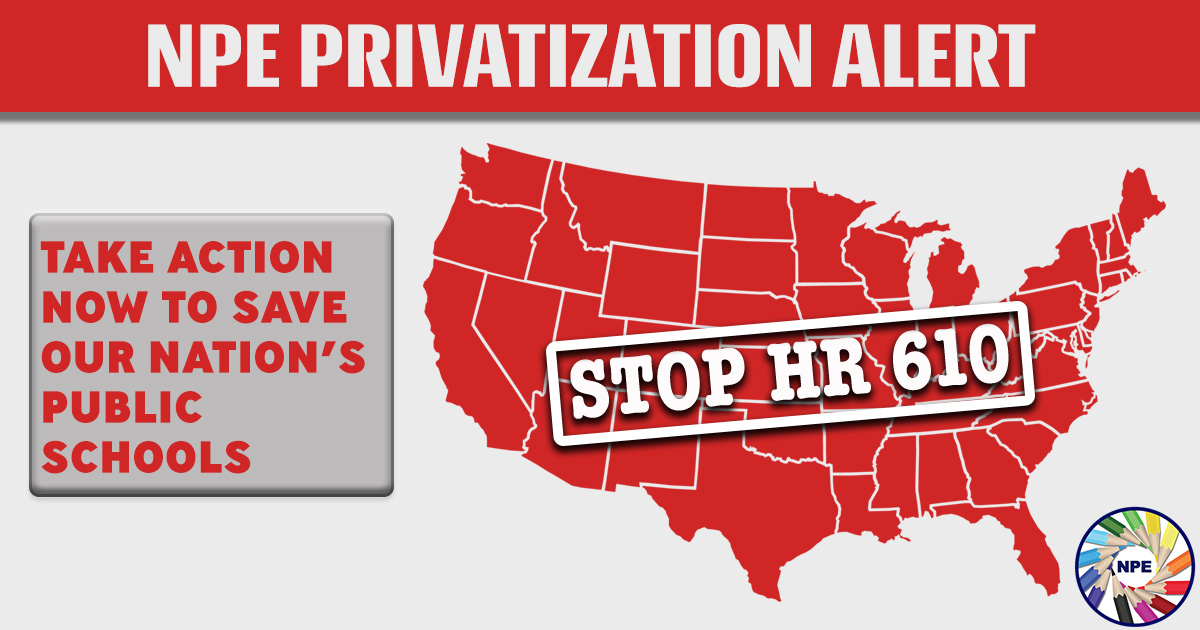
Also, please have a look at this urgent call to action from NPE, the Network for Public Education.  Voice your opposition to HR 610 which would undermine funding for the public's schools.


Please comment on my post here

Wednesday, February 8, 2017

Let's work together to Educate All Our Children.  Below is a listing of a CVPE (Community Voices for Public Education) event to be held in Houston on February 9.  Support of these voices is more important than ever.


RSVP Here


Please comment on my post here

Tuesday, February 7, 2017

Please forward Diane Ravitch's eloquent summation of the DeVos confirmation to all of your friends, your neighbors, your elected officials.  Let your children and their teachers know that you stand with them and will be a tireless advocate for them and for their schools.  Then call or write every elected official who will need extraordinary courage to stand up against the harmful policies that will start to impact our schools; let them know you'll be right there with them as they stand up to DeVos's determination to dismantle our schools.

And to those public officials -- right now 50 senators -- who were too scared to stand up for the public's schools, let them know that you know when the next election comes around , you'll be watching to see if they cave to the DeVos legislative agenda or have the courage to listen to the parents and teachers and business leaders and civil rights organizations in their states and vote for strong, equitable public schooling.


Please comment on my post here

Thursday, December 15, 2016

Ten-year-olds tackle ‘The Lie’ of demeaning stereotypes in video


Video source:  Washington Post


Albert Schweitzer (I believe it was in the "Teaching of Reverence for Life") wrote that we do harm to children -- and to our world -- when we encourage them to "grow out of" their natural early idealism.  When I circulated this video made by children speaking up against hate, Pansy Gee, recently retired teacher of 10-year-olds, sent this spontaneously eloquent and hopeful response:

I am pleasantly not surprised by the kids' reactions.  For the most part, kids are open- minded, blind to skin color, tolerant, and much more loving of their fellow man than adults.     The indignant reactions of children, when confronted with issues of prejudice or stereotypes is the one of the truest forms of social justice and  hope for the future.  It is when the adults in their lives deem that children are "old enough" to be "taught" about the "real world" that they begin to conform to their parents' world.  It is why I chose most of the books I did.  I wanted to open those lines of communication.  Sometimes I was not well liked by the parents. 

Reading those books about the prejudices of post-civil war times in Mildred Taylor's Friendship, the way the Okies were treated in California as depicted in the Cobblestone Magazine, or issues of personal freedom in The Giver and the discussions that ensued are what I miss about the classroom.  I am not just another adult voice that perhaps the kids would listen to.  I hope I am encouraging open minds, blindness to skin color, tolerance and love (or at least respect) for all. If children learned to read, write and talk skillfully and understand that we don't all have to agree on everything, their community, our world would be a bit more sane.  I hope teachers see the importance of reading REAL texts about REAL issues and give the boys and girls the opportunity to not just know the material, but to wrestle with it.  It's good to let them think through and struggle with the problems of their world. Teachers should give them chances to form opinions and to stand on the knowledge they're learning as support. Every teacher should have a classroom community where ideas are encouraged and can be exchanged safely, where minds can change more than once and no matter what-- as a class we care about each other! 

Tuesday, December 13, 2016

BE CAREFUL WHAT YOU CENTRALIZE!
Or, A Lesson My Teacher Taught Me  

When President Jimmy Carter created the Department of Education as a cabinet department in 1979, educators across the country were thrilled.  In the post-US/Vietnam war era, the education of America’s children would have the same official standing as the US treasury, the military (“defense”), agriculture, and foreign affairs. No longer sandwiched in between “Health” and “Welfare,” Education would leave the old HEW department and be an official national priority:  a Cabinet department.  Surely this independent standing would create leverage for research funding, for special programs, for innovation and, most important, for implementing and monitoring and enforcing equity – the rights of all children to an equitable education.   Teachers, parents, and educators at all levels celebrated this affirmation of their work and of the children.


By Spencer Rich Washington Post Staff Writer
The Washington Post (1974-Current file); Sep 28, 1979;
ProQuest Historical Newspapers: The Washington Post pg. A1

But I heard a word of caution.  John Palmer, my doctoral dissertation advisor and Dean of the University of Wisconsin School of Education, is a historian and an astute observer of the uses of power.  He saw the new Cabinet department through a different lens.  I recall his very quiet words of wisdom:  “You know, when you create a new program or a new structure, you have to think very carefully about whether this is what you would want to have in place if the other party were in power.  What might this new department mean if the other party were in control of it?”

For some reason, those words stuck in my mind. Perhaps because John Palmer is one of the wisest people I know and, yes, though I was officially his student all those years ago, he continues to be my teacher.  At the time, I think we thought the worst that could happen would be reduced funding for education research and for attention to such critical issues as special education, bilingual education, and the advocacy and enforcement of equity provisions not always reliably maintained by some of the states.

Never did we (or, at least, I) envision that having “the other party in power” would mean a threat to the very existence of the nation’s public schools.  The public’s schools.  Yet that’s where we are:  a person whose stated goal is to destroy the public’s schools has been appointed to be the United States Secretary of Education.  A person who has given hundreds of millions of dollars to elect politicians willing to de-fund the public’s schools and shift the public’s tax dollars to corporate charter chains: to private companies that will get rich at public expense using our children as the raw materials in their money machines.

Our schools – and our teachers – have survived four recent Secretaries of Education of questionable qualifications, often open antipathy toward teachers, and a deficit view of children and their families.

I personally heard Rod Paige, when he was superintendent of Houston’s public schools, describe Mexican American parents who called his office concerned that in late October their high school-age children still did not have textbooks as “interfering with my [his!] schools.”  Margaret Spellings seemed chosen just to keep the Texas-style accountability system in place under George W. Bush.  Arne Duncan famously bragged about closing schools in Chicago, a red flag that should have been an immediate disqualification, especially when President Obama had other, stellar, choices among talented and dedicated educators to choose from.  Duncan and Obama doubled down on the Bush policies of punishing under-funded schools rather than investing in them and their children, giving the corporatizers (Democrats as well as Republicans) the excuse they needed to justify closing schools in minority neighborhoods, shifting our tax dollars to wealthy charter chains and their money managers, and generally promulgating a rhetoric of “failing schools.” (And of John King, the less said the better.)

So in walks Betsy DeVos.   It doesn’t matter that Donald Trump knows nothing about public education, its central role in our democracy, its anchoring of our communities and their local economies and civic life.  If he knew that the public’s schools are pillars of our democracy, are a true public good, he wouldn’t agree or even be interested.  But he didn’t have to know. We  learn now that Betsy DeVos has been pursuing a “long game,” for years funding politicians to do her bidding to destroy the public’s schools, to weaken the teaching profession for its voice in education policy and its previous fairly reliable votes for Democrats and their pro-public education policies.  Her “long game” is to divorce the education of children from the control of their parents and the people their parents elect.

So now we look at all those functions (and budgets) under the centralized control of a Secretary of Education and recall those cautionary words of my great teacher, John Palmer: is this the structure you’d want to have in place if the other party were in power?

Professor Palmer’s close colleague and another professor of mine, Herb Kliebard, expressed the caution differently.  He always told us that as chaotic as the American system of public education is, with so many local, county, state and federal jurisdictions overlapping and often contradicting each other, that chaos was in fact the strength of the system: federal policies mitigated the racist exclusions in George Wallace’s Alabama, federal and state funding brought special education to poor or reluctant school districts, and local school boards had to answer to parents.   The potential for crazy still lurked at all levels, but all these intersecting policy venues assured that no one bad policy was controlling the whole system.

The chaos a Betsy DeVos will wreak is not what Herb Kliebard had in mind.  He saw openings for dialogue, for invention, for questioning, for local quirkiness, for experiment on the one hand and for holding on to good traditions on the other.     Conservatives need to remember their mantra against “big government.”  Progressives need not to feel we have to apologize for invoking democracy. We will have to build new coalitions of resistance to fight privatization of education, to protect our treasured public good, and to assert positive solutions at every jurisdictional level, leveraging the chaos where we find it.

Our children deserve no less. Our democracy depends on the education of its people.


Friday, November 18, 2016

COLONIZING BY TEXTBOOK, Part 3
See What Organizing Can Do!


Image source:  http://kxan.com/2016/09/13/rally-says-controversial-mexican-american-textbook-is-inaccurate-offensive/


History was made today! The State Board of Education of Texas rose above its almost caricatured record of questioning whether Supreme Court Justice Thurgood Marshall and civil rights labor leader Cesar Chavez are worthy role models for our children by voting unanimously to reject – to not approve – the racist, erroneous Mexican American Heritage "textbook."

While we applaud the good sense of the members of the state board of education, real credit goes to the parents, educators, scholars and friends of Texas children who showed what democracy can do:  they organized, they publicized, they studied, they brought their deepest concerns and their scholarly expertise and their families’ stories into the debate.  They built a coalition to reject racism. They also built that coalition to affirm what is just and inclusive and historically authentic.

I applaud historian Emilio Zamora and his Nuestro Grupo colleagues for doing the  tedious work of a fine-grained review of this proposed book. And I applaud the thousands who became informed, signed the petition opposing this book, and made their opposition known through calls, letters, emails and testimony.

This is what democracy looks like! This is what democracy can do!

Image source:  http://www.nbcnews.com/news/latino/texas-textbook-dripping-racism-opposed-hearing-awaits-vote-n647911
Here is the board’s decision.  Also check out Professor Angela Valenzuela’s testimony at the hearing, and the testimony of historian Emilio Zamora

Our work isn’t finished.   Bills are already being drafted to shift our tax dollars from the public’s schools to the corporate charter chains as soon as the legislative session opens in January.    Our kids deserve strong public schools.  We can stop the charter movement.  

We’ve seen what organizing can do!


To comment on this post click on the word "comment" below

Thursday, August 11, 2016

GUNS, SCHOOLS, AND KIDS   
Part 1
Missing Molly Ivins

When the Texas legislature in its 84th legislative session passed new laws permitting the “open carry” of hand guns and “campus carry” of guns on university campuses, my first thought was “Where is Molly Ivins when we need her?”

I could just picture the lead sentence in her next day’s column:  “Why are all those guys in the lege eager to make their masculine insecurities so public?”  

Molly Ivins’ wit skewered the pompous and the fear-mongering alike.  She made us laugh at the absurdities of our politicians’ ignorance, the often petty and equally as often overtness of their corruption, and the cruel impact many of their actions had on the most vulnerable Texans.
https://www.thenation.com/article/tough-bob-war-and-other-stuff/

In my next few blog posts, I’ll be reflecting on what it means to live in a state where a majority of legislators think carrying a gun around is good public policy. And I’ll be inviting readers to situate this whole guns on campus thing in the context of teaching and learning, the increasing diversity of the students on our campuses, and the seeming ubiquity of violence as a commonplace in our communities --- violence against young unarmed Black men and boys, violence as domestic or international terrorism, violence as public policy, and violence as the product of fear more even than a cause of fear.  And I’ll write about the emerging pushback against official violence, including actions that students and professors are taking to resist or overturn these “carry laws.”

A rumor going around Austin claims that at least one member of the legislature requires everyone on his staff to apply for an “open carry” permit.  Some versions of the rumor add that the staffers have to own and carry a gun; another version is that they just have to go through the training to get one and bring their “carry” license in as proof.  A litmus test for staffers:  no pacifists need apply?  no freedom of expression in this office?   My mental picture is of an NRA official making regular rounds to our legislators’ offices with a suitcase of campaign cash to be handed over only after inspecting each staffer’s gun “carry” license.  (I mention this rumor here in the hopes that one of you who knows the legislature will write to tell me this is absolutely NOT true! Surely, if true, it’s not legal…..)

If you live in Texas, you’ll want to know who voted for these laws.  Check the lists to see how your legislator voted, and if you don’t want the moms in the carpool lane or the check out clerk at the grocery store, or the folks next to your kids at the movie theater to be “carrying” a gun, ask the candidates in your district what they are going to do about it:  Ask “do you favor open carry gun laws in our neighborhoods and on our campuses?”  and “if elected, will you work hard to rescind these laws?”  We do, after all, have an election in a few months and  the 2017 legislative session coming up in January.

And if you want to know what Molly Ivins did say about “our infatuation with guns,” read her 1993 column so titled. She ends with this discussion of the Second Amendment:

“’A well-regulated militia’ surely implies both long training and long discipline. That is the least, the very least, that should be required of those who are permitted to have guns, because a gun is literally the power to kill.  For years, I used to enjoy taunting my gun-nut friends about their psycho-sexual hang-ups – always in a spirit of good cheer, you understand. But letting the noisy minority in the National Rifle Association force us to allow this carnage to continue is just plain insane….I do think gun-nuts have a power hang-up.  I don’t know what is missing in their psyches that they need to feel they have the power to kill.  But no sane society would allow this to continue. 

“Ban the damn things. Ban them all.  You want protection? Get a dog.”


Where is Molly Ivins when we need her?


To share your thoughts, click on the word “comments” below.

Friday, July 15, 2016

NIXON REDUX?
For those of you too young to remember, Richard Nixon chose the unqualified and reputedly corrupt governor of Maryland, Spiro T. Agnew, to be his vice president, purportedly to "impeachment-proof" his presidency.


It didn't work.

Let's hope the choice of  Indiana governor Mike Pence as a national candidate to be second in line for the presidency of our democracy never comes that close.

A cynical choice just when our nation, our children, the public's schools, our health care system, our need to end wars, our hunger for racial and economic justice, -- and our very planet -- deserve wisdom, not mean-spirited mediocrity -- at the top of the ticket, or in second place.

Sunday, June 19, 2016

BORDERS:  WALLS OR BRIDGES?
TEACHING THE US-MEXICO BORDER, Part 3


Image Source:
http://www.npr.org/2014/12/08/369383189/some-liberals-and-tea-partiers-unite-to-oppose-trade-deals

NAFTA, The TPP, and the “”Why Do We Have to Learn This?” Question!

It’s hard to think of anything more yawn-inducing for a social studies lesson than having to learn about a treaty.     The textbook formula for “treaty” has a sentence or two about the reason (the war ended, new trade routes were established, territorial disputes ended), the signers (the countries or warring parties, or maybe a president who made it happen, or two infamous enemies), and (if the paragraph is more than a few lines long), what happened afterwards.    The sterile textbook prose gives little indication of the fraught conditions and deeply held conflicts that led to the treaty, and even less hint that this “good” and maybe even “inevitable” treaty led to even greater negative consequences.  It’s signed, it’s done – on to the next “fact.”

Not so with NAFTA. And definitely not so with the TPP.    NAFTA, a treaty to reduce tariffs and other trade barriers between the US, Canada and Mexico, took effect in 1994, with claims of creating more jobs, reducing consumer prices, and dramatically improving the economy throughout Mexico.    Did “free trade” deliver on its promises?   Opponents of the TPP look at jobs in the US, poverty in Mexico, and say “No!”   NAFTA is one reason the TPP is being hotly debated by the current presidential candidates in the US and by environmental, labor and corporate groups in the countries involved.

Why spend some time this summer planning lessons about trade treaties?  Because, according to critics of the TPP, if it goes into effect, it could shift more US jobs to other countries, exempt corporations from a country’s laws protecting the environment and insuring the rights of workers, and put corporations “above the law” – beyond the financial regulations and tax policies of any country not favorable to that corporation’s profits.    A treaty for the 1%.

How to make sense of the proposed TransPacificPartnership  without a Ph.D. in economics, a law degree,  fluency in several Asian languages, and access to the documents produced in great secrecy and not yet released to the publics who will be affected by the treaty’s provisions?  Just because something’s important to know about doesn’t mean it will be easy – or even practical – to try to teach it.

Once again, Rethinking Schools comes to the rescue! The Line Between Us, their exciting collection of curriculum resources on the US-Mexico border, takes NAFTA as the touchstone for a comprehensive study of the ways individual lives on both sides of the border are shaped by a treaty that is anything but a dry fact in a history book.  NAFTA, designed in theory to transcend national borders, has instead been a creator of barriers, a source of new conflicts, and enforcer of new obstacles to economic development and personal mobility.

The resources and activities that enable students to step into NAFTA, its claims and provisions, and into the lives of workers and communities transformed by this trade agreement, are powerful for understanding the “border” from multiple points of view. And these lessons give us a template for helping kids – especially those who’ll be old enough to vote this fall – feel informed enough to ask serious questions about the still-pending TPP.

About the curriculum resources:  The NAFTA section of The Line Between Us includes a summary of NAFTA’s provisions, analyses by the Institute for Policy Studies (an invaluable resource), Bill Moyers’ powerful video Trading Democracy on the ways corporations, not workers, are empowered by NAFTA.   Necessary background. But what students will connect with are the personal stories of Mexican farm laborers, stories that then make an explanation of neo-liberalism by an immigration and refugee rights group worth understanding.  And the statement of “How We See the World,” the voice of Zapatistas in Chiapas on the degradation of work and workers’ conditions under NAFTA , a powerful motivator not only to pay attention to “trade agreements,” but to take all of their claims as questions to be investigated.  Questions like “who will profit from this?” and “who will be harmed?”
Image source:  https://www.youtube.com/watch?v=qlHxrGdzoJ8

But just reading these compelling sources is not the same as stepping into the world according to NAFTA:  for that, this curriculum provides role play activities in which students can step into the persona of a US worker whose job was taken by his company to low-wage Mexico, a Mexican farm laborer whose pay has decreased when US produce is dumped on international markets, a young maquiladora worker who risks kidnapping and murder to work in a US-owned factory along the border, or a US capitalist who may have wished to keep jobs in his home state but can’t resist the profits NAFTA makes so attractive if he moves his factory across that national border.  Students research their character’s lives before and after the treaty, examine what reasoning might have prompted the treaty’s provisions and promises, and explore first-hand accounts of post-NAFTA life. “Border,” “immigration,” “free trade” become not facts in a textbook or slogans in a campaign but realities in people’s lives.     

What is “free” about “free trade”?  Did NAFTA make economies stronger and lives better for people in three North American countries? Or is it an agreement “designed by and for transnational corporations and investors?”  Can workers move freely across borders? Or are borders “open” only to the movement of capital, of wealth?  

The Line Between Us was published in 2004.  Yet its lessons could not be more timely. The wage scales debated in the role play are those being debated today.  The questions of who has power, who decides, who bears the costs and who profits are not test questions: they are the questions about the TPP that students can learn to analyze – and maybe answer – if they step into the world according to NAFTA.

See my next posts for compelling novels and some non-fiction titles that are fine literature on their own and sure to bring the “border” to life for your students.

Friday, June 3, 2016

BORDERS:  WALLS OR BRIDGES?
TEACHING THE US-MEXICO BORDER, Part 1


I am a shameless promoter of Rethinking Schools, the organization itself, its publications, and especially its advocacy for social justice as a central component of what we teach, not as an add-on or special project.

That’s what makes The Line Between Us such a valuable resource for making the US border with Mexico not a political slogan of fear and exclusion, but a dynamic feature of our country’s history and a signifier of opportunities for asymmetrical conflicts or cross-national peace.

For teachers spending part of their summer preparing lessons in history, literature, world studies and cultures for their fall courses during this volatile and (in some cases) anti-immigrant election cycle, I urge you to grab a copy of this book.


The Line Between Us does not shy away from controversy.   The volume, authored by social studies educator Bill Bigelow, brings together historical sources, personal narratives, poetry, photographs and policy documents  for “teaching about the Border and Mexican Immigration.”  Unlike textbooks that sanitize the effects of colonization or simplify “history” through a single lens, The Line Between Us gives students ways to listen to, to think about, and to ask smart questions about this contested, emotionally and politically charged area.

All of Rethinking Schools publications – its journals and especially its curriculum publications, are respectful of teachers’ knowledge and of teachers’ role in engaging students in meaningful thought based on multiple credible and intellectually rich sources of information. 

Today’s headlines carry stories of “illegal aliens” crossing the Rio Grande River by night, or hidden in freight trucks coming through border check points, the “invasion” coming up from south of “the border.”  The Line Between Us shows that current  “border” to be  historically constructed, specifically constructed in the 19th century by “invaders” coming not from the south, but from the north and east – Americans under US President Polk using military force, as well as economic pressure, to add a huge section of Mexico (yes, a section of the nation of Mexico) to US territory.   (Imagine if Canada decided it wanted Microsoft and Seattle, so it sent the Mounties to take Washington state!)

I can only imagine how shocked many of our students will be to see the book's maps that show the Mexico of 1830 and the much smaller Mexico of today after the original “border” was violated and moved to its present configuration along the Rio Grande. The accompanying historical analysis explains how thousands of miles of border was shifted, dramatically altering two nations and their futures.  Rethinking our mental borders of territory, of “the other,” of histories as constructed and chosen and resisted, makes The Line Between Us  uniquely valuable for studying the US border with Mexico and for giving us a framework for examining the choices and forces behind other “facts” in our history books and in our politicians’ claims.

My next posts will highlight several of the activities the authors have developed to engage students in seeing the border through the eyes of those who have enacted the policies that govern it and those who live with the consequences of those policies.

If you are one of the hundreds of teachers whose teaching of the US-Mexico border has been informed by The Line Between Us, I hope you’ll share your experiences – and your those of your students – in the Comments section here.

Friday, May 6, 2016


The Tyranny of Testing:  Houston Parents Resist!


Here in Houston, where we're embarrassed to admit all this high-stakes test-based accountability started (remember when W was governor and Rod Paige was superintendent of schools here?), parents are organizing against high-stakes testing and FOR reclaiming the mission of the public's schools:  to teach all our children well.

Community Voices for Public Education unites parents, teachers and friends of the public's schools to resist the harmful effects of the testing system (not just "the test," but the whole toxic system).  Knowledgeable about teaching and learning, astute about the power politics and big money behind the testing, and tireless in bringing people together from across this huge city, CVPE offers a forum for discussing the personal and the political in testing. 


Parents gather to strategize how to best protect their children while not making their children's good teachers and principals even more vulnerable if high-scoring children are the ones whose tests scores are "absent" from the accountability calculations. They make common cause with teachers in getting smarter about the legislative process.  And they've encouraged the creation of an OPT OUT Academy as a creative and educationally rich alternative to choosing among multiple choice answers for hours and hours on test days.

If you're in Houston, find a way to add your voice, and expertise, to Community Voices for Public Education.  And if you're not in Houston, find a way to organize with the parents and teachers who are kindred spirits where you live -- we have a legislative session coming up in January 2017 and bills are already being written.   And an election between now and then. The pro-testing, anti-public school folks are very organized and already at work looking for ways to cut funding for schools and teachers, shift our tax dollars to the charter chains and use kids' test scores to justify all these bad policies.   Opting Out takes away the data that keeps the "accountability system" going; organizing on behalf of real, equitable educational schools needs everyone who cares about our kids.

CVPE will be hosting another Opt Out Academy May 9-13 and provides an opt-out guide on their website as well.  Check out all their resources for parents and community resisting standardized testing of our children.