Translate

Showing posts with label privatization. Show all posts

Tuesday, July 17, 2018

Can a Hurricane Wipe Out Democracy?


In her powerful book, Shock Doctrine:  The Rise of Disaster Capitalism, Naomi Klein explained the ways disasters – both natural and man-made – can be so destructive, can leave people so vulnerable, that a hostile takeover may be welcomed as a rescue.  Specifically, a hurricane or a political coup or a tsunami may wipe out so much, and leave people so desperate, that they’ll agree to anything that seems like a quick fix. Especially, as Klein describes, “fixes” that they would never agree to under normal circumstances, would never vote for.

The “shock,” then is the disaster. The “shock doctrine” is the strategic goal to replace democratic institutions, public goods owned by and governed by the people, with private, corporate entities that make a profit off what was once the public’s.  Klein traces the privatization doctrine back to economist Milton Friedman, then tracks his influence through not just the spread of his ideas but also specific individuals who studied under him and took government jobs or think tank consultancies in countries like Chile during the time of Pinochet (the case of a “disaster” being a violent, anti-democracy political coup). 

For those of us in education, the most compelling chapter may be the story of New Orleans after Hurricane Katrina flooded most of the city, dispersing its population across the country and disrupting most city services, including the schools.   Before New Orleans’ public school teachers could return to the city, before any of the public’s schools had been rebuilt, the corporate forces and their politicians moved in with their shock doctrine fix:  close the public’s schools and replace them with corporate charters.   Using the public’s tax dollars of course.   A Louisiana member of Congress, even before the flood water receded, that “Hurricane Katrina did to the Lower 9th Ward what we’ve never been able to do politically.”  Meaning, wipe out this mostly African American neighborhood and “re-develop” it for profit.   New Orleans voters would never vote to close their schools or fire their teachers; but, hey, a hurricane took care of that messy chore in Lower 9th and other mostly poor, mostly African American communities. We know what came next: public school teachers fired, replaced by much less qualified Teach for America and other less credentialed people in for-profit or (supposedly) non-profit corporate charters of questionable educational quality and documented detriment of democratically governed, community-based schools.

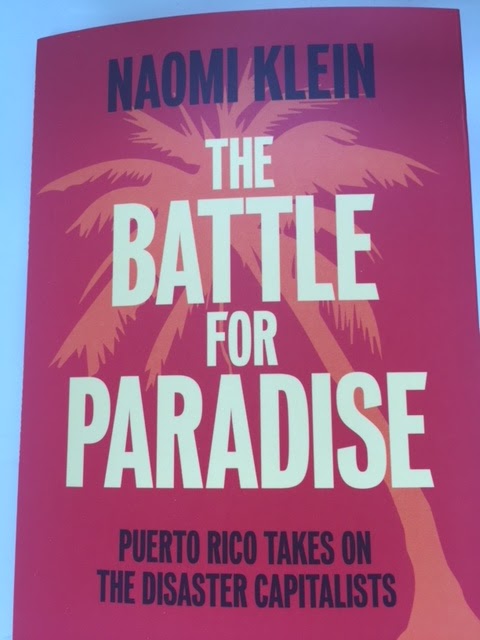
It’s in that context of corporatizing traditionally democratic institutions that Klein’s new book takes us to Puerto Rico, where the “shock” of Hurricane Maria had already been preceded by the “shock” of Wall Street, colonizing the Puerto Rican economy by complex forms of new indebtedness to the big banks and investment firms.  Into this already precarious – and largely avoidable – financial situation roared Hurricane Maria last September, essentially wiping out the island’s infrastructures for electricity, communications, roads and bridges, and its schools. The Battle for Paradise  documents this next round of post-disaster predatory capitalism – exploiting the exhaustion of thousands who still lack electricity with a plan to privatize (corporatize) the power grid, taking advantage of people still struggling to find drinking water and medical supplies and ways to repair their homes by cutting deals with high level officials to turn every possible public institution into a profit stream for corporate interests. The schools are not immune: a plan to charterize schooling, shutting down not only the schools that need rebuilding but many that were never damaged (since the publication of this book, a judge has ruled against the charter plan. But the fight is not over)

But Puerto Ricans are fighting back.  The Battle for Paradise is the story of that struggle.  It does not sugar coat the huge financial and political powers aligned to undermine democracy in the island.    It is in the face of those daunting powers that people are coming together in new and creative alliances to shape the rebuilding of Puerto Rico’s social institutions at the same time as, and as seamless with, the rebuilding of the physical infrastructure.

The book arose out of a forum on the dangers of disaster capitalism to “undermine our country’s well-being, especially that of our most vulnerable inhabitants.  These [corporate privatization] policies will limit access to basic rights such as water, electricity, and housing and will destroy our environment, health, and democracy, as well as our quality of life …and all the while they will increase the transfer of wealth to the already rich.”

Klein also sees hope. This slim volume contains beautiful examples of the strength of communities working together. My favorite is Casa Pueblo, a civic and community center where 20 years earlier solar panels had been installed, to the derision of many. While politicians dragged their feet, highly questionable contracts were signed with completely unequipped repair companies, and huge areas of the island remained without power for months, Casa Pueblo had light!  Literally, electricity, but figuratively as well:  a beacon of collaboration, sensible science, community-based practicality.   People came from miles away to charge phones and medical devices, prepare healthy meals, convene community gatherings.

The battle for paradise is – and will be – a struggle between democratically, locally-based, community-strengthening rebuilding, or  the predatory displacement of local control by corporate investors exploiting the shock of financial and hurricane disaster for greed and profit:  supported by the wealthy in gated enclaves unaffected by the long-term harm to the island’s schools and neighborhoods and daily activities.   Klein’s book holds out hope because she has spent time with and seen up close the 60 organizations that have come together as JunteGente (people together) to build a democratic Puerto Rico.  She knows time is of the essence, the people with money and power can move more quickly and irreversibly, the collision of the two visions of Paradise is inevitable. 
 
The Battle for Paradise is not just local to Puerto Rico:  Klein’s analysis captures the threat to democracy in our larger society and, especially, in our schools.  I offer her book as a prelude to the new series of posts which, following The Children Are Watching, will trace the battle to protect the America’s public schools – so central to our democracy – from those who would destroy them and replace them with a “market” of corporate charter chains.  I’m calling that series Grand Theft Schoolhouse.  In the model of Naomi Klein I hope to write concretely and clearly about what is at stake when “disaster capitalism” walks through the doors of our children schools.   And I hope to highlight, as she does, those examples of civic action and hope which are essential to ending not only disaster capitalism but the vulnerabilities it so shamelessly exploits.

To share your thoughts, click on the “comments” pencil.

Friday, April 7, 2017

AN INCONVENIENT GOSPEL: THE CHRISTIAN RIGHT SPELLS “PROPHET” WRONG

Being neither a theologian nor a scholar of Greek, Hebrew or Aramaic, I have hesitated to write about what passes as “Christian” in a lot of conservative language and policies.  Especially strange is the way “love thy neighbor” has been lost in the cacophony of voices against immigrants, Muslims, Jews, women, people living in poverty.  Whatever happened to taking care of “the least of these”?  Did our Sunday school teachers have it all wrong?  I really have struggled to figure out how people calling themselves Christians could say so many hateful things – and in public, on posters and t-shirts they’re wearing, sometimes shouting from microphones.

It’s not that I’m naïve about the uses of Christianity to justify slavery or subservient roles for women or wars against Muslim countries. And I know that’s not all just a history that’s nicely wrapped up in embarrassing rationalizations in our history books.

But really!  We have people in office bragging about de-funding Meals on Wheels, determined to take away health insurance from the sickest among us – our neighbors who may be too sick to hold a job, much less a job that provides good health benefits.
And these are the same people (you, Paul Ryan and Ted Cruz and….) who claim Christian values guide their decisions.

Image source:  http://d.christianpost.com/full/70797/img.jpg
I’m not qualified to do an exegesis of the gospel according to these self-identified Christian politicians, so I could not be more grateful that Nicholas Kristof has done it for us.  He writes to Pious Paul (Ryan) in the voice of Jesus, reminding him that our mission is to take care of the “least of these.”  Kristof crushes the transformation of “prophet” into “profit” in the Christian-right lexicon. 

Here is Kristof’s Jesus explaining to Ryan why he should learn from the Good Samaritan, though Ryan’s admiration is for the rich guys who passed by the suffering traveler to take care of their own business:

A man was attacked by robbers who stripped him of clothes, beat him and left him half dead. A minister passed down this same road, and when he saw the injured man, he crossed to the other side and hurried on. So did a rich man who claimed to serve God. But then a despised Samaritan came by and took pity on the injured man. He bandaged his wounds and put the man on his own donkey and paid an innkeeper to nurse him to health. So which of these three should we follow?”
“Those who had mercy on him,” Pious Paul said promptly.
Jesus nodded. “So go ——”
“I mean the first two,” Pious Paul interjected. “For the Samaritan’s work is unsustainable and sends the wrong message. It teaches travelers to take dangerous roads, knowing that others will rescue them from self-destructive behaviors. This Samaritan also seems to think it right to redistribute money from those who are successful and give it to losers. That’s socialism! Meanwhile, if the rich man keeps his money, he can invest it and create jobs. So it’s an act of mercy for the rich man to hurry on and ignore the robbery victim.”

Then Jesus’s response to Ryan’s idea that prayer is “universal health care,” and that Jesus would be smarter to invest with the Donald in for-profit hospitals, making a little for himself on the side:

Jesus turned to Pious Paul on his left and said: “Be gone! For I was hungry and you gave me no food; I was thirsty, and you gave me no drink; and I was sick, and you did not help me.”
“But, Lord,” protested Pious Paul of Ryan, “when did I see you hungry or thirsty or sick and refuse to help you? I drop your name everywhere. And I’m pro-life!”
“Truly I say to you,” Jesus responded, “as you did not help the homeless, the sick — as you did not help the least of these, you did not help me.”


Read the column, pass it on, and pray (if such is your tradition) for this gospel of hate to wear out its welcome before too many more people get hurt.   Imagine if our national conversation right now kept coming back to the question of whether we and our policies really were taking care of the least of these.


Please comment on my post here

Friday, March 24, 2017

On the Radio: What Damage Can Betsy DeVos Actually Do to the Public’s School?


If you’ve accepted my invitation to imagine a Secretary of Education for America’s  Children and a Secretary of Education for the Public’s Schools, you may wonder what led me to (perhaps somewhat wildly) fantasize a person holding that office who is moved by the gravity of the responsibility to act wisely and forcefully as the first and highest advocate for our children, their learning, and their well being.

The idea of imagining possibilities came to me as I prepared for a radio interview with Dan Angelo, whose Education Today has for 25 years provided a forum for in-depth conversations about critical issues in education.  Mr. Angelo asked me to speak about the implications for our schools should DeVos be able to enact her stated agenda of dismantling the public’s schools and shifting our tax dollars to private religious schools, corporate charters and online “education” companies.

Needless to say, doing my homework for the interview was not pleasant. The more I read about the damage DeVos left behind in Ohio (including having to pay fines for violations of campaign laws) and Michigan (charters with dismal records of student learning, in close proximity to the now closed or marginalized public schools), the more I feared for America’s children and for the future of the vital role our public education system has played in creating and, to now, sustaining our democracy.

I was dismayed to read the ways that DeVos and other privatizers trick the public by claiming that private schools that take our money (through direct tax dollars to charters or indirectly through vouchers) are “public schools.”  Nope and nope.  The obfuscating terminology, the wholesale attacks on all public schools, the blaming of teachers and schools that have been starved for resources – the DeVos record was painful for what it’s done and frankly terrifying for what she plans to do as a member of the Cabinet under a president who himself is hostile to public goods and public institutions of all kinds.  

You can read my interview that “homework” produced.  I talk with Dan Angelo, host of EducationToday on Quartermoon Radio, about what Betsy DeVos hopes to do to our public schools:
   
You’ll see why the more I learned about DeVos, the more I kept imagining what would someone do as Secretary of Education who had, to paraphrase Albert Schweitzer, a reverence for children’s lives, a weighty sense of obligation to their schools and to the democracy we’ve promised they’ll grow up in.  Imagining an alternative was an exercise in hope.

I hope you’ll add your own imaginings to my previous posts on such a Secretary of Education, and check back in a few days to see how I’m imagining a Secretary of Education for America’s teachers.


Please comment on my post here

Thursday, March 23, 2017

DON’T LET VOUCHERS KILL THE PUBLIC’S SCHOOLS!


With Betsy DeVos in as US Secretary of Education, we know our public schools are not safe.  A new administration should have come in ready to do away with high-stakes testing and other punitive policies and jumped right in to use the Secretary’s power – and budget in the billions of dollars – as a force for the most academically rich, culturally grounded, child-centered and, of course, equitable schools we can as a nation imagine. 

Instead, we see a Secretary eager to use the power of her office to impoverish the public’s schools by robbing them of our tax dollars, giving them to private schools.  Betsy DeVos wants our public dollars to leave our children’s classrooms and fly across town into the pockets of people who run schools but for some reason can’t make them financially viable on their own.   Religious schools (in her case, Christian ones), corporate-run charter chains, independent private schools – these are the folks who want a handout from the government!   Education “welfare”?

We can call it theft, misappropriation, corporate welfare, or de-democratizing.  Betsy DeVos calls these cash transfers “vouchers,” “freedom scholarships,” “market payments.”

Vouchers by whatever name will take money out of our public schools, making them weaker and – surprise! – vulnerable to closure or take over by private interests.    The president’s proposed budget takes billions of federal dollars away from even basic services to put into vouchers – voucher programs that states may have to go along with to get other federal dollars they desperately need in such areas as special education.  And many Republican governors and state legislatures are voting on voucher bills this very month (including, my Texas neighbors, right now in Austin).

“Vouchers” sound neutral; “freedom scholarships” sound generous.  How can we explain to our friends, our legislators, and our members of Congress how dangerous vouchers are?

A teacher can tell us!  Mercedes K.Schneider is a public school teacher in Louisiana, a careful researcher, and writer who can explain the most complicated policies in clear prose even a legislator can understand!     Her new book is here just in time to give to your member of Congress or state representative before they get sucked into thinking vouchers are inevitable, vouchers “worked” in Michigan (they didn’t), vouchers help poor kids (no).  SchoolChoice:  The End of Public Education?(Teachers College Press, 2016) traces vouchers to their roots in Southern resistance to desegregation:  if white families could take their local school tax dollars to private schools not under the Supreme Court’s Brown v. Board of Education Topeka, they could keep their kids in all-white schools – and at the public’s expense.  

Schneider shows vouchers to be fundamentally aimed at destroying democracy, starting with Milton Friedman’s goal of replacing public institutions (the public’s institutions) by private players in a market where “competition” would be the only form of regulation.  And private interests would have no obligation to collective governance.   Her section on “choice” is especially compelling: Schneider shows that when tax dollars – and kids – go to voucher and charter schools, it’s the schools, not the parents and children, who have the power of “choice”: to include, to exclude, to do less than advertised.  Not good for children, not good for the community, and definitely not consistent with our democracy.

Get Schneider’s book today – for you, your teachers and school board, your policy folks, your local library!  Keep our dollars in our classrooms.  Anyone who wants to start a private school should try it; but raise your own money.  The rest of us have already committed our tax dollars to the public’s schools.

 comment on my post here

Wednesday, March 15, 2017

ACTION NEEDED AGAINST VOUCHER LEGISLATION

For my readers in Texas, Raise Your Hand Texas reminds us that Vouchers Hurt!  Call and write your state senators NOW to let them know you're not fooled by "tax credit scholarship voucher," "Education Savings Accounts," or any other trick label that takes dollars out of our children's classrooms and turns them over to profiteers and private interests.   Tell them: we know theft when we see it.  And we're watching.  Vouchers hurt the public's schools. A vote for vouchers will hurt you in the next election!


UPDATE:  
The Senate Education Committee on voucher legislation has been RESCHEDULEDfor Tuesday, March 21.

Please comment on my post here

Friday, March 3, 2017

Imagine a Secretary of Education for America’s Schools

Source:  http://maxpixel.freegreatpicture.com/static/photo/1x/Imagine-Dream-Teaching-Inspire-Classroom-1182585.jpg
When the President of the United States appoints a Secretary of Education who openly, vocally, and financially works to destroy the public’s schools, we can sigh and hope to outlive her time in office, giving what support we can to the teachers we know and the schools that serve our communities.  Or we can declare the experiment in democratic education over (as some have already done), and shed tears for what this generation of children will miss and what our country will lack when their schools are closed and they, and their friends, are outsourced to private “education management companies” called “charter schools.”

Or, we can heed Maxine Greene’s admonition to foster in each other a social imagination – the imagination to envision a more just society, a creative public spirit, and a collective sense of urgency to make democracy work for everyone.  For Greene, an esteemed professor at Teachers College and a tireless advocate for educating through the creative arts, a social imagination was not idle musing or wishing what might have been.  An informed social imagination leads to action for justice.


Source:  https://c1.staticflickr.com/8/7286/27345059694_5b19ae9dfb_b.jpg
I invited readers to imagine along with me what it would mean if we had a Secretary of Education for America’s children:  a cabinet member who understands the gravity of being the voice of the children –all our children – at the highest levels of government, and who acts accordingly.   Now we need to imagine what a Secretary of Education would do in her first months in office if she understood, cared about, and used her power to advocate for the public’s schools.

Again, cue up John Lennon’s “Imagine” or maybe “What a WonderfulWorld.”  And let’s imagine together…..

Imagine a Secretary of Education who understands that an investment in America’s infrastructure absolutely must include making sure that every public school, in every neighborhood, is built as an engaging learning environment and an asset to its community. That secretary would call in the Secretary of Labor to remind him that building good schools, and renovating older ones, is a great for job creation – for the workers immediately employed and for economies that that powerful learning will generate in the schools they build.  Our imagined Secretary would enlist the Secretary of Health and Human Services and colleagues NIH and the CDC and EPA for their expertise in assuring the building materials are built with children’s health in mind, safety from toxic chemicals, with clean air and water a given.  She’d of course call on the expertise of the Department of Energy and the professional organizations of school architects for specs on energy efficiency and renewable systems throughout, to model for the children a reverence for nature’s resources as well as to reduce expenses.

Imagine a Secretary of Education who tells the Congress and the President and infrastructure designers to get ready to build, but not until she has consulted with teachers and parents about what they want their school buildings to be.  Lively learning centers, yes.    Abundantly equipped, yes – even in the poorest neighborhoods, the most remote rural counties.    And inviting to all – a place where teachers want to teach, children are excited to spend their days, parents and neighbors know they are welcome to visit and volunteer.   Well acquainted with the amenities in private schools, the Secretary will already know that teachers need offices and conference rooms for study and lesson prep and collaborating across disciplines; teachers won’t have to ask for those basics. But teachers will want to weigh in on things this particular Secretary of Education may not think of – a community clinic with mental health services as well as basic family medicine, spaces for parents to meet, a community liaison who knows well the families’ languages, needs, assets and network of referral services throughout the community.

Imagine a Secretary of Education who understands that learning involves all the senses.   She might take a literal walk in the park to confer with the National Park Service, the US Forest Service, the Secretary of the Interior as well as the leaders of Nature Conservancy and various urban park systems to ask how they could work together to make sure every American child has places to play outside. She would have read Last Child in the Woods on the plane in from Michigan and arrived fired up to get America’s kids outdoors, exploring, discovering, skinning their knees and – the radical part – getting to play!

I’m beginning to like this imagined Secretary of Education.  Though I doubt she’ll materialize on her own. It will take a village – a very large and energized village and its teachers – to “raise” her.  In a future post, we’ll imagine what she might learn from America’s teachers – if she did decide to become the Secretary of Education for all of America’s children and all of the public’s schools.


Add your imaginings to mind in the Comments section here:

Monday, February 20, 2017

Betsy DeVos' Educational Marketplace Concept is Absurd

I'm happy to share my recent OpEd in the Dallas Morning News.  Your feedback and comments are invited!

Betsy DeVos’ educational marketplace concept is absurd


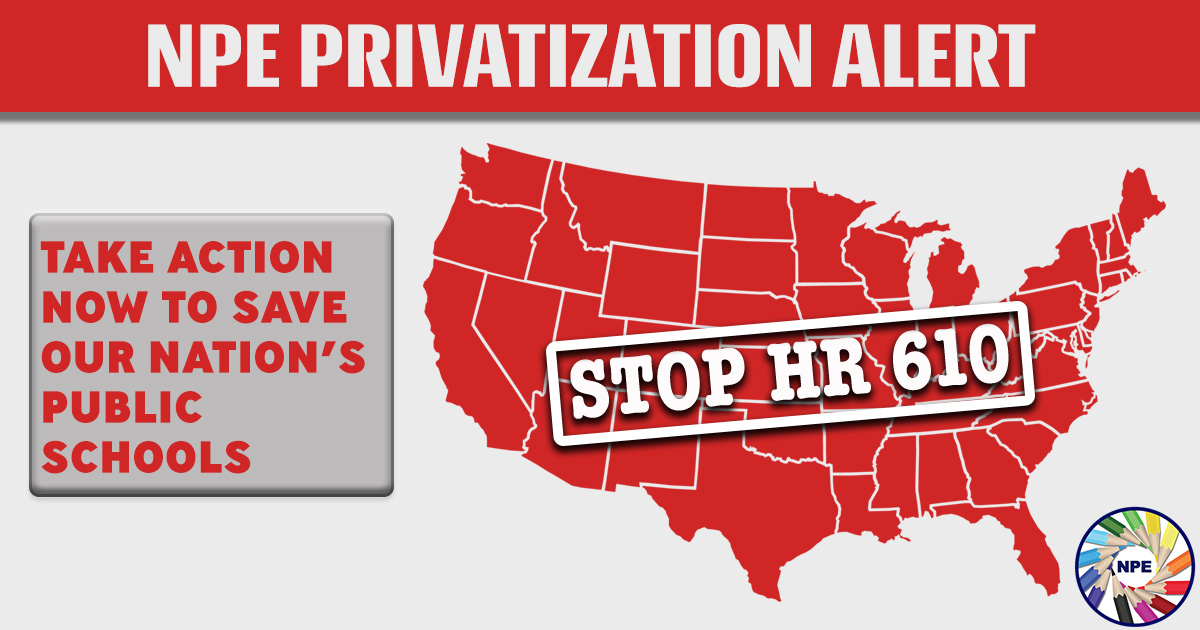
Also, please have a look at this urgent call to action from NPE, the Network for Public Education.  Voice your opposition to HR 610 which would undermine funding for the public's schools.


Please comment on my post here

Tuesday, December 13, 2016

BE CAREFUL WHAT YOU CENTRALIZE!
Or, A Lesson My Teacher Taught Me  

When President Jimmy Carter created the Department of Education as a cabinet department in 1979, educators across the country were thrilled.  In the post-US/Vietnam war era, the education of America’s children would have the same official standing as the US treasury, the military (“defense”), agriculture, and foreign affairs. No longer sandwiched in between “Health” and “Welfare,” Education would leave the old HEW department and be an official national priority:  a Cabinet department.  Surely this independent standing would create leverage for research funding, for special programs, for innovation and, most important, for implementing and monitoring and enforcing equity – the rights of all children to an equitable education.   Teachers, parents, and educators at all levels celebrated this affirmation of their work and of the children.


By Spencer Rich Washington Post Staff Writer
The Washington Post (1974-Current file); Sep 28, 1979;
ProQuest Historical Newspapers: The Washington Post pg. A1

But I heard a word of caution.  John Palmer, my doctoral dissertation advisor and Dean of the University of Wisconsin School of Education, is a historian and an astute observer of the uses of power.  He saw the new Cabinet department through a different lens.  I recall his very quiet words of wisdom:  “You know, when you create a new program or a new structure, you have to think very carefully about whether this is what you would want to have in place if the other party were in power.  What might this new department mean if the other party were in control of it?”

For some reason, those words stuck in my mind. Perhaps because John Palmer is one of the wisest people I know and, yes, though I was officially his student all those years ago, he continues to be my teacher.  At the time, I think we thought the worst that could happen would be reduced funding for education research and for attention to such critical issues as special education, bilingual education, and the advocacy and enforcement of equity provisions not always reliably maintained by some of the states.

Never did we (or, at least, I) envision that having “the other party in power” would mean a threat to the very existence of the nation’s public schools.  The public’s schools.  Yet that’s where we are:  a person whose stated goal is to destroy the public’s schools has been appointed to be the United States Secretary of Education.  A person who has given hundreds of millions of dollars to elect politicians willing to de-fund the public’s schools and shift the public’s tax dollars to corporate charter chains: to private companies that will get rich at public expense using our children as the raw materials in their money machines.

Our schools – and our teachers – have survived four recent Secretaries of Education of questionable qualifications, often open antipathy toward teachers, and a deficit view of children and their families.

I personally heard Rod Paige, when he was superintendent of Houston’s public schools, describe Mexican American parents who called his office concerned that in late October their high school-age children still did not have textbooks as “interfering with my [his!] schools.”  Margaret Spellings seemed chosen just to keep the Texas-style accountability system in place under George W. Bush.  Arne Duncan famously bragged about closing schools in Chicago, a red flag that should have been an immediate disqualification, especially when President Obama had other, stellar, choices among talented and dedicated educators to choose from.  Duncan and Obama doubled down on the Bush policies of punishing under-funded schools rather than investing in them and their children, giving the corporatizers (Democrats as well as Republicans) the excuse they needed to justify closing schools in minority neighborhoods, shifting our tax dollars to wealthy charter chains and their money managers, and generally promulgating a rhetoric of “failing schools.” (And of John King, the less said the better.)

So in walks Betsy DeVos.   It doesn’t matter that Donald Trump knows nothing about public education, its central role in our democracy, its anchoring of our communities and their local economies and civic life.  If he knew that the public’s schools are pillars of our democracy, are a true public good, he wouldn’t agree or even be interested.  But he didn’t have to know. We  learn now that Betsy DeVos has been pursuing a “long game,” for years funding politicians to do her bidding to destroy the public’s schools, to weaken the teaching profession for its voice in education policy and its previous fairly reliable votes for Democrats and their pro-public education policies.  Her “long game” is to divorce the education of children from the control of their parents and the people their parents elect.

So now we look at all those functions (and budgets) under the centralized control of a Secretary of Education and recall those cautionary words of my great teacher, John Palmer: is this the structure you’d want to have in place if the other party were in power?

Professor Palmer’s close colleague and another professor of mine, Herb Kliebard, expressed the caution differently.  He always told us that as chaotic as the American system of public education is, with so many local, county, state and federal jurisdictions overlapping and often contradicting each other, that chaos was in fact the strength of the system: federal policies mitigated the racist exclusions in George Wallace’s Alabama, federal and state funding brought special education to poor or reluctant school districts, and local school boards had to answer to parents.   The potential for crazy still lurked at all levels, but all these intersecting policy venues assured that no one bad policy was controlling the whole system.

The chaos a Betsy DeVos will wreak is not what Herb Kliebard had in mind.  He saw openings for dialogue, for invention, for questioning, for local quirkiness, for experiment on the one hand and for holding on to good traditions on the other.     Conservatives need to remember their mantra against “big government.”  Progressives need not to feel we have to apologize for invoking democracy. We will have to build new coalitions of resistance to fight privatization of education, to protect our treasured public good, and to assert positive solutions at every jurisdictional level, leveraging the chaos where we find it.

Our children deserve no less. Our democracy depends on the education of its people.


Monday, November 21, 2016


Re-posted from Diane Ravitch's blog


Parents, Educators, Advocates Demand Federal Protection of Student Privacy


Diane writes:  A coalition of parents, educators, and privacy advocates issued a statement in defense of student privacy, which is threatened by efforts to create a massive federal data base containing personally identifiable data.